From Politico's Morning Energy:
Thursday the Environment and Economy panel will go after EPA’s plans for federal regulations on coal ash and other waste products from coal-fired power plants. EPA is considering two options for the rules: one preferred by environmental groups that would regulate ash as a hazardous waste and set binding standards for its disposal, and another industry-backed option that would declare ash non-hazardous, giving states more leeway in setting their own disposal standards.

Showing posts with label epa. Show all posts
Showing posts with label epa. Show all posts
Monday, April 11, 2011

EPA escapes the cut
The EPA barely escaped becoming collateral damage in last week's budget battle.
"EPA ESCAPES – The EPA has emerged unscathed from Friday’s last-minute budget deal as Democrats successfully fended off GOP attempts to cripple the agency’s climate regulations.
The agreement includes “no climate change or EPA language,” a senior aide to Senate Majority Leader Harry Reid said after the deal had been brokered Friday, and the agency went unmentioned in a summary circulated by House Speaker John Boehner. Even a proposed study of the economic consequences of environmental regulations – a compromise Senate Democrats appeared ready to accept on Friday – has been dropped from the final deal, as Obama and Boehner found little common ground on the study’s specifics.
Republicans had hoped to use their budget leverage to strip EPA of its climate authority, as well as to attack regulations on mountaintop removal mining, coal ash waste from power plants and a host of other agency initiatives. Ultimately, the GOP dropped its anti-EPA provision at the eleventh hour, having used it to leverage billions in spending cuts."
Read the rest at Politico's Morning Score.
Plus, the fight over the air toxics protection begins: "On Friday the Energy and Power panel is back in action to take on EPA’s air quality regulations for industrial boilers, power plants and cement manufactures."
Stay tuned!
Thursday, April 7, 2011
Sulphur Springs Mercury Hair-Testing Event
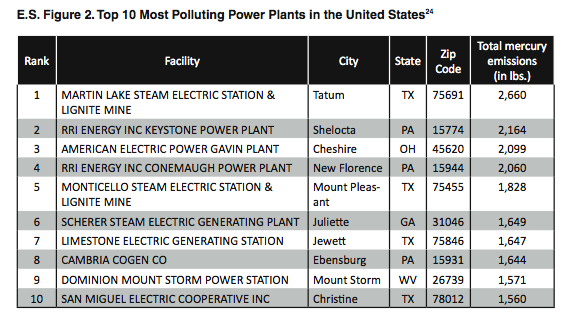
Last week, folks in Sulphur Springs gathered at their local Pizza Hut to talk about the effects of a lignite mine in their backyards and the Monticello coal plant, only an hour away. About twenty people were in attendance, and nine folks got their hair tested.
If you want to host a mercury hair-testing event in your area, email
If you want to host a mercury hair-testing event in your area, email
flavia.delafuente@sierraclub.org


Tuesday, March 29, 2011
Final Standard for Air Toxics
EPA Issues Final Standard to Protect Americans from Boilers’ Toxic Air Pollution
Health protections will modestly reduce dangerous emissions
Washington, D.C. – Today, the U.S. Environmental Protection Agency released a final health standard that will limit emissions of mercury, lead, arsenic, acid gases and other toxic pollutants from industrial boilers. This commonsense air toxics safeguard, often called the “Boiler MACT (Maximum Available Control Technology),” will save thousands of lives, and prevent thousands of cases of asthma attacks, heart attacks and hospital visits.
Industrial boilers are on-site power plants at places like universities and industrial facilities like chemical plants, refineries and paper mills. By controlling these plants’ pollution, EPA’s air toxics safeguard will protect Americans from breathing some of the most dangerous and toxic pollutants known to us – arsenic, lead, acid gases and mercury. Even in small amounts, these life-threatening air pollutants are linked to cancer, birth defects, brain damage and even early death. Without this critical protection, millions of tons of air toxics will continue to be released into our air each year.
“Corporate polluters are literally making us sick, and these long overdue protections from EPA will save lives and improve the health of millions of Americans,” said Michael Brune, Executive Director of the Sierra Club. “Though the announcement today is modest by comparison to the proposals put forth by the EPA last June, we urge Administrator Lisa Jackson to forge ahead to protect our children and families’ health.”
Not content with having weakened important protections like the air toxics safeguard, polluting industries continue to push their agenda to roll back and even block public health protections and clean air standards.
“If the corporate lobbyists succeed in killing these health protections, Americans will pay the price with the lives and health of their family members,” said James Pew, staff attorney at Earthjustice. “Controlling the toxic pollution from industrial boilers will save lives, prevent billions of dollars in unnecessary health care costs, and put thousands of Americans to work.”
Who's got the MACT?
Not Texas. And we need it.
Due to the Clean Air Act, the EPA will be proposing a series of public health protections this year, including boiler MACT, which is intended to limit hazardous air pollutants, or air toxics. The boiler MACT (maximum available control technology) protection will cut down on emissions of air toxics like mercury, arsenic, lead, dioxin, and acid gases.
How? It basically means that all of our dirty ol' powerplants will need to install equipment to match the best-performing and cleanest plants for each type of pollutant. Existing power plants will have more time to meet the standard—taking into account available technologies and cost.
To be clear: mercury is a neurotoxin. It can cause central nervous system damage. It is the reason for which many lakes and rivers have warnings about eating the fish, and why pregnant women are advised not to eat any seafood at all.
Of course, some people don't think the EPA should exist, or enforce the Clean Air Act, blah blah blah. Well, forget them. We need this. And we need to show that we want the EPA to do its job.
Get Active. Sign up to be a Texas Healthkeeper.
But why should Texans care?
One teaspoon of mercury is sufficient to contaminate a 20-acre lake. Our lakes.

But we'll let these pictures do the talking: it's probably worth a thousand words.
 From Environment Texas.
 From Environment Texas.

From Environment Texas.
Ready to protect our Texas rivers, our land, and most importantly, our health?
Join us!
Get Active. Sign up to be a Texas Healthkeeper.
Flavia de la Fuente
Conservation Organizer

Due to the Clean Air Act, the EPA will be proposing a series of public health protections this year, including boiler MACT, which is intended to limit hazardous air pollutants, or air toxics. The boiler MACT (maximum available control technology) protection will cut down on emissions of air toxics like mercury, arsenic, lead, dioxin, and acid gases.
How? It basically means that all of our dirty ol' powerplants will need to install equipment to match the best-performing and cleanest plants for each type of pollutant. Existing power plants will have more time to meet the standard—taking into account available technologies and cost.
To be clear: mercury is a neurotoxin. It can cause central nervous system damage. It is the reason for which many lakes and rivers have warnings about eating the fish, and why pregnant women are advised not to eat any seafood at all.
Of course, some people don't think the EPA should exist, or enforce the Clean Air Act, blah blah blah. Well, forget them. We need this. And we need to show that we want the EPA to do its job.
Get Active. Sign up to be a Texas Healthkeeper.
But why should Texans care?
One teaspoon of mercury is sufficient to contaminate a 20-acre lake. Our lakes.
But we'll let these pictures do the talking: it's probably worth a thousand words.
 From Environment Texas.
 From Environment Texas.
From Environment Texas.
Ready to protect our Texas rivers, our land, and most importantly, our health?
Join us!
Get Active. Sign up to be a Texas Healthkeeper.
Flavia de la Fuente
Conservation Organizer
Related articles
- Republican Budget Launches Sneak Attacks on Clean Air Protections (switchboard.nrdc.org)
- Court Admits Blame for Med-Waste Incinerator Confusion (nytimes.com)
- Boiler Battle (pubs.acs.org)
- Why Mercury is a Problem (sierraclub.typepad.com)
- EPA Seeks to Delay Controversial Air Pollution Rules for Boilers (nytimes.com)
Thursday, August 26, 2010
Study identifies 39 Additional Contaminated Coal Ash Sites
From Environmental Integrity Project
Days before the US Environmental Protection Agency (USEPA) kicks off a series of regional hearings across the United States on whether and how to regulate toxic coal ash waste from coal-fired power plants, a major new study identifies 39 additional coal-ash dump sites in 21 states that are contaminating drinking water or surface water with arsenic and other heavy metals. The report by the Environmental Integrity Project (EIP), Earthjustice and the Sierra Club documents the fact that state governments are not adequately monitoring the coal combustion waste (CCW) disposal sites and that the USEPA needs to enact strong new regulations to protect the public. The report shows that, at every one of the coal ash dump sites equipped with groundwater monitoring wells, concentrations of heavy metals such as arsenic or lead exceed federal health-based standards for drinking water, with concentrations at Hatfield’s Ferry site in Pennsylvania reaching as high as 341 times the federal standard for arsenic.

Days before the US Environmental Protection Agency (USEPA) kicks off a series of regional hearings across the United States on whether and how to regulate toxic coal ash waste from coal-fired power plants, a major new study identifies 39 additional coal-ash dump sites in 21 states that are contaminating drinking water or surface water with arsenic and other heavy metals. The report by the Environmental Integrity Project (EIP), Earthjustice and the Sierra Club documents the fact that state governments are not adequately monitoring the coal combustion waste (CCW) disposal sites and that the USEPA needs to enact strong new regulations to protect the public. The report shows that, at every one of the coal ash dump sites equipped with groundwater monitoring wells, concentrations of heavy metals such as arsenic or lead exceed federal health-based standards for drinking water, with concentrations at Hatfield’s Ferry site in Pennsylvania reaching as high as 341 times the federal standard for arsenic.
For the Press Release, click here.
For Report, click here.
For News Conference audio, click here.
Tuesday, August 17, 2010
Tuesday, August 3, 2010
Cancer: Coal's Hidden Cost
FOR IMMEDIATE RELEASE
March 6, 2007
Contact:
Lisa Evans, Earthjustice (781) 631-4119
Eric Schaeffer, Environmental Integrity Project (202) 296-8800
Jeff Stant, Clean Air Task Force (317) 359-1306
Neil Carman, Sierra Club Lone Star Chapter (512) 472-1767 or 512-299-5776
Cancer: Coal's Hidden Cost.
New EPA Risk Assessment finds extraordinary cancer risk; lack of federal regulations endanger
While EPA has not yet formally released the revised assessment, environmental groups received a summary of the draft, which indicates that the cancer risk for adults and children drinking groundwater contaminated with arsenic from coal combustion waste dumps can be as high as 1 in 100 – 10,000 times higher than EPA’s regulatory goals for reducing cancer risks
EPA’s failure to limit pollution from coal combustion waste, or coal ash, has poisoned surface and groundwater supplies in at least 23 states, by EPA’s own admission. Coal combustion waste is the solid waste produced by coal-fired power plants, which produce approximately 129 million tons of the waste each year. The waste is contaminated with toxic chemicals such as mercury, arsenic, lead, cadmium, chromium and selenium. There are currently about 600 existing coal ash landfills and surface impoundments in the
There are currently plans to build over 150 coal-fired power plants in the
“
“We've seen surface water contamination by coal combustion waste and we’re concerned that without better rules governing disposal of this waste, both our surface water and groundwater resources are in danger,” said Travis Brown of Neighbors for Neighbors, a grassroots citizens' group.
Neighbors for Neighbors ranchers, farmers and rural residents based in Lee,
“The E.P.A. report should cause great concern for Texans, especially those who live near seventeen existing coal plants and the related dumping grounds for coal combustion waste.” said Brown.
A broad coalition of 27 environmental and public health groups, led by Earthjustice, Clean Air Task Force and the Environmental Integrity Project, recently submitted a proposal to EPA detailing ways to protect against pollution from the millions of tons of coal ash disposed annually by
“It’s very simple,” said Earthjustice attorney Lisa Evans. “Coal combustion waste currently disposed without adequate safeguards poses an imminent and substantial endangerment to health and the environment in dozens of communities throughout the country. EPA has made no effort to protect the public against these pollution sources for over seven years. We believe it is time to act.”
In 2000, EPA committed to establishing regulations for coal ash disposal. Since then, the agency has met repeatedly with industrial polluters and will soon issue a Notice of Data Availability (NODA), which is expected to defer federal waste regulation in favor of a voluntary industry agreement. However, the voluntary industry agreement, announced by a consortium of coal-fired electric utilities last fall, promises no controls on the hundreds of existing waste dumps and gives industry three years to place monitoring wells around dumps within a mile of drinking water sources.
Simple measures such as isolating the waste from groundwater, prohibiting dumping of coal ash in sand and gravel pits, and lining landfills and surface impoundments would have a huge impact on limiting pollution from these facilities.
“The people who are exposed to a greater cancer risk by drinking water poisoned by coal ash landfills and surface impoundments need to be heard,” said Jeff Stant, Director of the Power Plant Waste-Safe Disposal Project for the Clean Air Task Force. “EPA has ignored affected communities for far too long.”
“Many coal ash disposal sites lack the most basic safeguards such as liners, covers, and groundwater monitoring--standards that are routinely required for household trash at sanitary landfills,” states Eric Schaeffer, Director of the Environmental Integrity Project. “In fact, in many cases, the operators are simply dumping the waste straight into groundwater and face no cleanup requirements by states.”
The National Academies of Science (NAS) found in a March 2006 report studying the practice by utilities of dumping coal combustion wastes in coal mines, that high contaminant levels in leachate, or runoff, from coal ash dumps has contaminated drinking water and caused considerable environmental damage, including the local extinction of multiple species. The NAS report cited EPA’s commitment in 2000 to promulgate federal regulations to require adequate safeguards for disposal of toxic ash and called for the development of regulations mandating safeguards for minefilling. The Environmental Protection Agency, nevertheless, has neglected issuing these much needed safeguards.
Why should coal ash be classified as hazardous waste?
Great question!
We need to recognize that coal plant waste disposal facilities are huge, barely regulated toxic waste dumps. Some of the dumps are nothing more than strip mine pits and where they pollute the groundwater we depend on for drinking and agriculture. The power industry has been poisoning America's heartland for years, not only with air pollution but also with toxic waste.
The EPA clearly needs to regulate coal combustion waste under RCRA and listing it as a hazardous waste due to
1) toxic heavy metals (arsenic, beryllium, cadmium, chromium, lead, mercury, molybdenum, nickel, selenium plus other metals),
2) dioxins,
3) other cancer-causing organic compounds that are products of incomplete combustion, and
4) low levels of radionuclides. EPA has avoided doing this so far. No solid waste liners or any leachate monitoring are currently required, which is scandalous since ground water contamination can and is occurring.
Subscribe to:
Posts (Atom)